
What Is 340B Enrollment, and Why Does It Catch New Covered Entities Off Guard?
340B enrollment is the formal process by which an eligible healthcare provider registers with HRSA’s Office of Pharmacy Affairs Information System, known as OPAIS, to gain access to discounted outpatient drug pricing. It sounds like a paperwork exercise until a covered entity realizes that every registration choice, from pharmacy structure to patient eligibility definitions, carries audit consequences from day one.
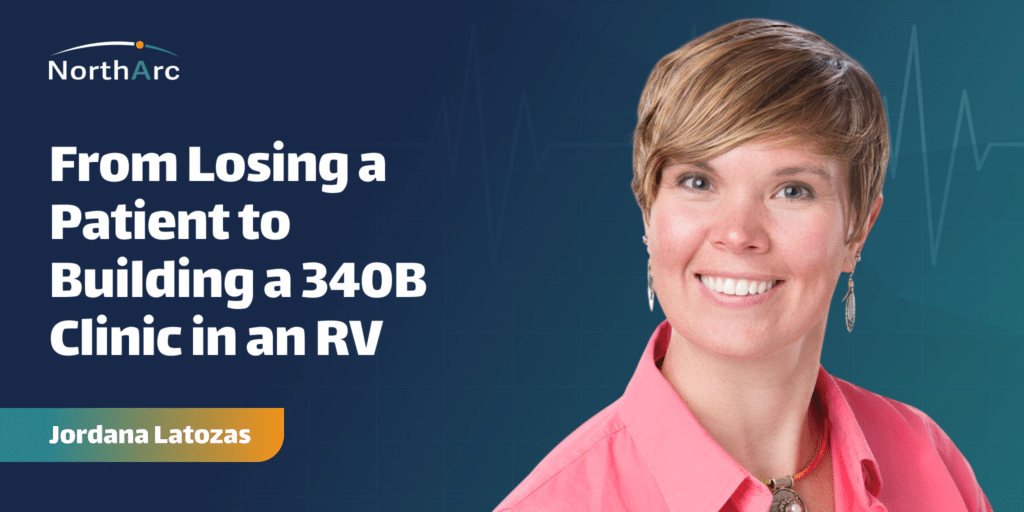
That gap between how simple 340B enrollment sounds and how complicated it actually is sits at the center of a recent episode of 340B Pulse, the NorthArc Health podcast powered by PureLogix. Host Mohammad Atif spoke with Jordana Latozas, a nurse practitioner in Michigan and founder of Recovery Mobile Clinic. This nonprofit mobile healthcare organization treats individuals with substance use disorder in homeless encampments, shelters, and transitional housing. Jordana’s 340B contract is barely a year old. Her account of enrollment and go-live is not theoretical. It is what actually happened.
Why Did Jordana Latozas Get Involved With 340B in the First Place?
Jordana got involved with 340B because her clinic’s Ryan White Part C Capacity Building Grant, secured to expand access for patients with substance use disorder and HIV exposure, tied directly into 340B eligibility. The connection came through a colleague who runs a pharmacy and recognized the fit.
Recovery Mobile Clinic exists because Jordana lost a patient. A 23-year-old woman, once a 15-year-old track star, was given opiates after a knee injury, became dependent, and was later on Suboxone for opiate use disorder. She had no reliable transportation to reach the clinic. She died of an opiate overdose at 23. Jordana’s husband, who sells RVs for a living, suggested putting a clinic inside a mobile unit and driving it to the patients instead of waiting for patients to reach a fixed clinic. That is how Recovery Mobile Clinic started in 2020. The organization is a nonprofit that bills Medicaid and Medicare but never turns away a patient for lack of insurance, because doing so would work against its own mission of expanding access.
What Part of 340B Eligibility Is Least Understood by New Entities?
The least understood part of 340B eligibility is that HRSA does not clearly define what makes a patient eligible. Covered entities are left to build and defend their own eligibility logic, which becomes a serious liability if an audit finds a patient was carved in incorrectly.
Jordana described sending “a lot of emails and a lot of phone calls to HRSA, to the state, to the Ryan White” program, trying to get someone to define eligibility for her. Nobody would. Her solution was to screen every incoming patient for STDs, which technically routes them into Ryan White eligibility for screening and treatment. That screening creates a documented paper trail: a form in the EMR marking each patient as eligible or not, ready to be produced the moment an audit call comes in. As Jordana put it, “Whenever you set up a program, not saying that I will get audited, but I always set up a program as if I’m going to.”
What Should Covered Entities Prepare For During Registration and Enrollment?
Covered entities should prepare for a dense sequence of administrative decisions made right at the outset, starting with OPAIS registration and the choice between an in-house pharmacy and a contract pharmacy arrangement. Getting this sequence wrong early is one of the most common sources of downstream compliance exposure.
Jordana called this stage “very confusing” with “a lot of layers.” Registering every pharmacy correctly on OPAIS, and deciding whether to run an in-house pharmacy or work with a contract pharmacy, is “a huge question going in and out” before a single 340B claim is ever purchased. She named the single decision that made the biggest difference for her: hiring a 340B compliance consultant, 340bauditors.com, before problems surfaced rather than after. I can’t tell you how often, how completely, implicitly impactful they’ve been with our rollout, because they’ve done this before, they can see, kind of, what’s coming.”
What Happens Between Enrollment Approval and Go-Live?
Between enrollment approval and go-live, a covered entity has to stand up a wholesaler account, finalize its pharmacy model, decide whether to bring in a third-party administrator, and keep all of those moving parts coordinated at the same time. Jordana described managing five pieces simultaneously: covered entity information, a contract or in-house pharmacy, a TPA, and a manufacturer or wholesaler relationship. She went with Cardinal as a wholesaler, though McKesson and others are common alternatives. “Keeping that momentum going over five areas can be a little tricky,” she said, especially from a coordination and logistics standpoint.
How Should a New Covered Entity Choose a TPA or Vendor Partner?
A new covered entity should choose a TPA or vendor partner based on responsiveness, not on a sales pitch. Jordana ran informal tests before signing with anyone: how long it took a vendor to respond to an email, whether they called back, whether someone gave her a direct cell phone number.
For a small nonprofit with a single-year 340B contract, that responsiveness is not a nice-to-have. “Time is of the essence, right? The rollout can’t take three years,” she said.
Who Is Actually Responsible When a Vendor Makes a Compliance Mistake?
The covered entity is always responsible when a vendor makes a compliance mistake, even if the error originated with a TPA, wholesaler, or contract pharmacy. HRSA holds the covered entity accountable for every eligibility determination and every carve-in decision made under its number.
Jordana, who is not a pharmacist, said that reality forced her to keep asking questions until she genuinely understood what her vendors were doing, “even if that took me a couple of times to really wrap my head around” the concepts. She was direct about the tradeoff: “Sometimes I just had to look stupid and say, okay, you’re gonna have to dumb this down a little bit for me.” That willingness to ask, rather than assume, is what let her track pricing, eligibility, and carve-in decisions closely enough to maintain a real compliance strategy.
What Is Jordana’s Honest Take on AI in 340B Operations?
Jordana’s honest take on AI in 340B operations is that it is “middle of the road.” It can help pull data together, but over-reliance on it is premature because an AI system is only as good as the data fed into it, and the covered entity remains liable even if the AI error originated with a vendor’s system.
She uses a small EMR called Clinic Tracker without leaning on its built-in AI features, and she is not certain how much AI her TPA’s platform uses internally. Her caution extends past her own tools: “You have to watch it, right, the AI is only as good as the data that’s being inputted… You have to have those checks and balances, because ultimately, again, it’s going to run back on the covered entity as being the one that’s responsible for it, even if you weren’t directly utilizing the AI program yourself.”
Why Did Jordana Call the Rebate Pilot Program a Delay Tactic?
Jordana called the rebate pilot program a delay tactic because it would have required covered entities to front the full cost of drugs and wait months for reimbursement, adding administrative burden without changing who actually benefits from 340B savings.
Her clinic runs on a paper-thin margin with a staff of roughly 30 people, some of whom are clinicians seeing patients directly. “If my program can’t keep running, all of those patients who rely on seeing us. won’t have access to our services anymore.” She also corrected a widespread misconception: 340B was never designed to lower drug prices directly for the patient. It exists to keep programs like hers financially viable so patients retain access at all. “It’s gonna bury you,” she said of the rebate delay model. “Your cash flow’s not gonna be there.”
What Advice Does Jordana Give Organizations Just Starting?
Jordana’s core advice for organizations just starting the 340B enrollment process is to find a consultant or mentor before doing anything else, because the raw compliance requirements read cold are enough to scare a new entity away entirely.
“If I just read through all of the court requirements for 340B, I mean, I know if I did, I wouldn’t have touched it with a ten-foot pole.” With the right guide walking a covered entity through the steps in order, she said, the program becomes feasible rather than overwhelming. [Internal Link: NorthArc Services]
Conclusion
Jordana Latozas built Recovery Mobile Clinic to solve a transportation gap that cost a patient her life, and 340B became the funding mechanism that lets that mission keep running. Her account of enrollment and go-live is a reminder that the program’s biggest risks rarely come from the pharmacy math. They come from ambiguous eligibility guidance, vendor relationships chosen for convenience instead of responsiveness, and the assumption that a checklist exists somewhere when it does not. For covered entities approaching enrollment today, the fastest path to a defensible, audit-ready program is the same one Jordana took: bring in an experienced consultant early, document eligibility as if an auditor is already watching, and choose vendor partners who answer the phone. To see how a custom technology and Agentic AI approach can support your organization’s 340B compliance foundation, consult with [External Link: Authoritative Source on HRSA 340B Program Requirements] or reach out to NorthArc Health directly.
Frequently Asked Questions (FAQ)
What is the hardest part of 340B enrollment for a new covered entity?
The hardest part is that HRSA does not provide a clear definition of patient eligibility, leaving covered entities to build their own documentation trail and defend it in the event of an audit.
How long does a 340B go-live typically take?
Go-live timelines are commonly underestimated. Jordana Latozas was told her rollout would take three months; it took considerably longer once wholesaler, TPA, and pharmacy coordination were factored in.
Should a new 340B program hire a consultant?
Yes. Jordana identified hiring a 340B compliance consultant before go-live as the single highest-impact decision in her rollout, since an experienced consultant already knows what triggers an audit and what documentation an auditor will request.
Is a covered entity responsible for its vendors’ compliance mistakes?
Yes. HRSA holds the covered entity accountable for eligibility and carve-in decisions regardless of whether the error originated with a TPA, wholesaler, or contract pharmacy.
Does 340B lower drug prices directly for patients?
No. 340B was designed to let safety-net providers stretch savings into keeping their programs and access points running, not to reduce the price a patient pays at the counter.
Is AI ready to manage 340B compliance decisions?
Not yet, according to Jordana Latozas. AI can help organize data, but over-reliance on it is risky since the output is only as reliable as the data entered, and the covered entity remains liable regardless of which system made the error.