

340B Transparency: 4 Hidden Gaps State Reports Miss
Permalink: 340b-transparency
By NorthArc Health, with insights from 340B Pulse guests. Last updated 5 November 2026.
340B transparency means being able to show, with records, how 340B dollars move: what a covered entity earns, what it pays to outside vendors, what drug prices it should receive, and what patients gain. It matters now because states are already requiring reports and Congress is weighing more.
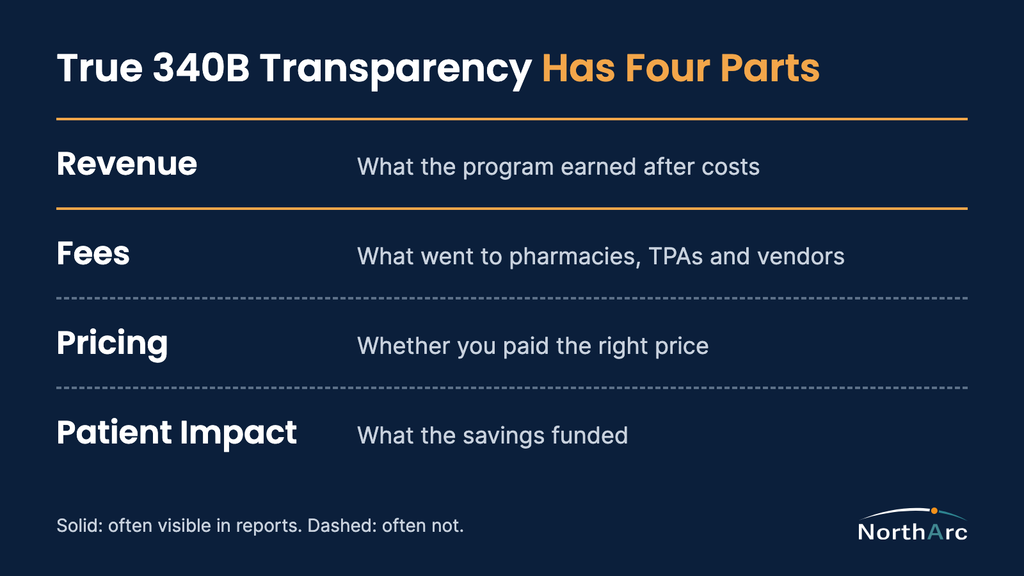
Most of the debate treats 340B transparency as one question: should hospitals report more? That question is real, but it covers only part of the picture. A report can be filed on time and still leave a CFO unable to explain where the money went. True transparency has four parts, and most reporting laws reach only some of them.
Key takeaways
- 340B transparency covers four things: revenue, outside fees, drug pricing and patient impact.
- At least eight states have 340B reporting laws as of 2026, and the requirements differ by state.
- Minnesota’s latest report shows at least $1.34 billion in net 340B revenue for 2024, and the state calls that a likely undercount.
- Minnesota covered entities paid about $10 to outside organizations for every $100 of gross 340B revenue.
- Federal reporting proposals are still proposals. We found no federal 340B transparency law enacted as of 5 November 2026.
- Most teams can start with data they already hold.
The strongest argument for preparing early comes from someone who works inside these programs every day. Robert Ferraro, PharmD, MBA, ACE, CEO of Ravin Consultants, told us on 340B Pulse: “I encourage covered entities not to be afraid of transparency.” In his view, reporting is the best way for covered entities to show what they’re doing.
What does 340B transparency actually mean?
340B transparency is the ability to trace 340B activity from drug purchase to patient benefit and show the evidence to someone outside your team. It’s different from compliance. Compliance asks whether you followed the rules. 340B transparency asks whether someone else could see and understand what happened.
Dr. Jonathon Harrison, President and CEO of Wellyfe, made the same distinction when talking about PBM contracts on 340B Pulse. He described “a transparent window, but if it’s foggy on the other side, you’re not really getting the full picture.” The word alone proves nothing. What counts is what you can actually see.
Here is how much of each part is visible today.
| Part | The question | Visibility today |
|---|---|---|
| Revenue | What did the program earn after costs? | Growing, through state reports |
| Fees | What went to contract pharmacies and TPAs? | Partial, and depends on the state and your contracts |
| Pricing | Did we pay the right price? | Limited to authorized covered entity contacts |
| Patient impact | What did the savings fund? | Weakest, and often not collected |
Which states have 340B reporting requirements?
As of 2026, at least eight states have laws requiring some 340B reporting: Colorado, Idaho, Indiana, Maine, Maryland, Minnesota, Ohio and Washington. That list combines NACHC’s April 2026 tracker and HFMA, because we found no official national count. Check your own state’s current law.
The requirements vary, but they tend to ask for similar data. Ferraro listed the usual items as total 340B purchase volume, estimated savings and payer mix. He added that some states also want contract pharmacy fee structures, and that Medicaid carve-in status comes up often because states help fund Medicaid.
Four examples show how far a state can go:
- Minnesota: covered entities must submit data to the state health department by 1 April each year, and the state’s FAQ says it can fine those that fail to provide it.
- Maine: a law signed in June 2025 calls for annual reports, publicly posted starting July 2026, with acquisition costs, payments received, units, claim counts and payer-specific detail by child site.
- Ohio: first data was due 1 July 2026, including payments to contract pharmacies and TPAs and an accounting of how 340B profit was spent. The state health department is to post the reports publicly.
- Washington: a law signed in March 2026 pairs contract pharmacy protections with reporting for both providers and drugmakers. A federal court declined to block it in June, and an appeal has been filed.
Other states are still studying the question. Illinois signed a study measure in August 2026, with findings due by 1 July 2028, and Virginia passed a stakeholder study bill.
Maureen Testoni, president and CEO of 340B Health, saw this coming at an HFMA conference in 2025: “It really feels like this transparency concept is coming and there’s not going to be a way around that.”
What does a 340B transparency report reveal?
A 340B transparency report can show revenue and costs clearly, but it may not show what the money funded. Minnesota’s is the most useful public example. Its second report to the Legislature, dated 27 February 2026, covers calendar year 2024.
| Minnesota, calendar year 2024 | Amount |
|---|---|
| Reimbursements for 340B drugs | $3.04 billion |
| Cost of acquiring those drugs | $1.53 billion |
| Operational costs, internal and external | About $165 million |
| Net 340B revenue | At least $1.34 billion |
The first year’s number was far off. Net revenue reported for 2023 was $630 million. The state says the jump is primarily due to more complete reporting of office-administered drugs, and it believes $1.34 billion is still an undercount. A team that can’t separate those drugs cleanly is likely to struggle with the same field.
Revenue is concentrated. The largest hospitals reported over $1 billion, more than 80% of the statewide total. Federal grantee clinics generated the least. One statewide number can hide very different programs.
The report stops at the program’s edge. The state’s FAQ says it doesn’t currently collect data on the activities covered entities support with net 340B revenue. So this detailed 340B transparency report still doesn’t answer the question most people ask: what did the money do? Other states go further: Idaho and Ohio both ask how savings or profits are used.
Where is 340B transparency still missing?
340B transparency is still weakest in the places reports rarely reach: outside fees, drug pricing and patient impact. Each one sits with a different party, so no single law or vendor fixes them all. Together with revenue reporting, they make up the four parts of the full picture.
What are covered entities paying outside vendors?
Outside fees are one of the clearest 340B transparency gaps. Minnesota covered entities reported paying about $120 million in contract pharmacy fees and $17 million in other external costs in 2024. The state says about $10 of every $100 in gross 340B revenue went to organizations such as contract pharmacies and TPAs.
Fees also fall unevenly. Contract pharmacy fees were about 70% of costs for hospitals but 42% or less for grantees. An older GAO review of 30 contracts found that all but one used a flat per-prescription fee, generally $6 to $15, and that some also took a percentage of revenue. Those numbers are from 2018, but the question stands: can you state your own fee per claim?
Harrison’s advice on PBM contracts applies to any vendor: “If it’s your data, you should be able to get it whenever you need it.”
Can covered entities verify drug pricing?
Only partly, which makes pricing a real gap in 340B transparency. Manufacturers report ceiling prices to HRSA each quarter, and since April 2019 HRSA has offered a secure site where covered entities can check them. Access is limited to each entity’s authorizing official and primary contact, so analysts doing the daily work may never see it.
A simple routine is to sample high-spend NDCs each quarter and compare invoice price against ceiling price, with someone named to follow up on differences.
Who can see manufacturer claims data systems?
Claims data is where 340B transparency becomes a dispute: manufacturers say they need it to check the program, and covered entities question who controls it and who pays for the systems that hold it.
Jason Bilyj, PharmD, ACE, Director of Pharmacy at Third Street, told us that if manufacturers want transparency, they should push for a “nationwide clearing house” rather than systems they set up and pay for themselves.
Celeste Fowler, Executive Director of Pharmacy 340B at Piedmont Healthcare, raised a related doubt. Covered entities already submit a lot of data through their TPAs and keep auditable records, she said, and “I don’t know that adding another vendor or space for additional information or data would actually change or increase transparency.”
The clearinghouse idea now appears in federal legislation.
What did the savings do for patients?
Patient impact is the hardest part of 340B transparency to show, and the part that protects a program most, because it answers the question critics ask.
Kalvin Pugh, 340B Policy Director at Community Access National Network, said on 340B Pulse that FQHCs and Ryan White AIDS Drug Assistance Programs are already required to report how they operate to HRSA. His ideal is a document showing “how many patients were served” and “how much we paid in fees.”
Thomasyna Sweed, Program Manager at LifeSpring Health Systems, put the benefit simply: “if you add some transparency, you can build trust.” A clear record of what savings fund can be more persuasive in a policy debate than a revenue total, and it’s worth having before anyone asks. For examples of how programs use savings, read our post on turning 340B savings into patient access.
What is Congress proposing on 340B transparency?
Congress is weighing several 340B transparency proposals, and none we reviewed has become law as of 5 November 2026. They differ in who reports, what gets reported and who sees it. Treat them as signals of what may be asked, not as requirements to budget for today.
| Proposal | Status we found | What it would ask for |
|---|---|---|
| Cassidy discussion draft | Released 25 June 2026; comments closed 28 August; not formally introduced | Margin reporting for DSH hospitals, with more detail above $200 million and $1 billion in revenue; a searchable public HHS database |
| SUSTAIN 340B Act | Introduced in the Senate on 5 August 2026 | Savings reporting through Medicare cost reports and a third-party clearinghouse for claims-level data |
Mark Capuano, PharmD, MBA, of NYC Health + Hospitals, expects a trade. Speaking on 340B Pulse, he predicted more transparency “around what covered entities are doing with those dollars,” and said of the path ahead: “It’s going to be a give and take.”
Medicare is moving separately. CMS’s Part D 340B repository opened for voluntary submissions on 1 October 2026, and CMS has proposed making it mandatory for claims from 1 January 2027. Check whether that proposal is final before you plan around it.
How can covered entities prepare without adding bureaucracy?
Good 340B transparency starts with the data you already hold, clear owners and one repeatable summary. Ferraro says most of what these laws require is “data that’s already readily available to covered entities.” You need a routine someone owns, not a new platform.
- Check your state’s law first. Confirm what applies to you, the due date, and whether your entity type is covered.
- Write down your savings method. Ferraro’s advice is to build a simple savings methodology and stick to it, so this year’s number can be compared with next year’s.
- Separate your revenue lines. Split retail and office-administered drugs early, since that’s where Minnesota’s numbers moved most.
- List every outside fee. Put contract pharmacy, TPA and other vendor fees in one table, per claim where you can.
- Check your contracts for data rights. Confirm you can get your own claim-level data, how fast, and in what format.
- Sample your prices. Compare a set of invoices against ceiling prices each quarter and record the result.
- Keep a patient impact log. Record what savings funded, how many patients it reached, and who approved it.
- Bring finance in now. Ferraro’s message: “controllers and CFOs, you know, prepare yourselves to be more involved in 340B.”
The same records support audit work, so this doesn’t have to be a separate project. See our guides to 340B audit readiness and 340B claims data submission. If contract pharmacy data is the weak spot, start with our post on contract pharmacy restrictions.
Here is what that can look like. A hypothetical two-person program at a critical access hospital spends one afternoon a quarter on this: it updates a one-page sheet with purchases, savings, fees per claim and three things savings funded. When the CFO, a board member or a state agency asks, the answer is already written.
Frequently asked questions
What is 340B transparency?
340B transparency is the ability to show how 340B dollars move and what they achieve. It covers program revenue, fees paid to outside vendors, drug pricing and patient impact. It usually comes up in state reporting laws and federal reform proposals, though neither covers all four.
What are 340B reporting requirements?
They depend on where you operate. State laws vary, but they often cover purchases, savings or revenue, payer mix, and sometimes contract pharmacy fees. Minnesota requires submission by 1 April each year. Check your own state’s current statute.
What is the Minnesota 340B transparency report?
It’s the Minnesota Department of Health’s annual report to the Legislature, based on data from covered entities. The latest, dated 27 February 2026, found at least $1.34 billion in net 340B revenue for 2024. The department says that figure is likely still an undercount.
Is there a federal 340B Transparency Act?
A bill called the 340B Transparency Act, H.R. 3290, was introduced in the previous Congress. Current proposals include the SUSTAIN 340B Act and the Cassidy discussion draft. We found no federal 340B transparency law enacted as of 5 November 2026, so check Congress.gov for the latest status.
What can 340B savings be used for?
The program has no single federal list of approved uses for every covered entity, and Pugh notes unclear HRSA direction on this point. Ferraro has seen food banks, transportation programs and mobile clinics. State law can add limits, as Colorado’s 2025 law does for hospitals, so document your uses and check local rules.
Do covered entities need new software for 340B reporting?
Usually not to begin with. Ferraro says most required data is already available to covered entities. The harder work is getting it into one place, with clear definitions and owners. Automation helps once the process is defined and someone is checking the results.
How should 340B leaders approach transparency?
340B transparency is coming through states first, and federal proposals show where the debate may go next. Teams that can already explain their revenue, fees, prices and patient impact will have less to scramble for when a new request arrives. They’ll also have the stronger case to make.
NorthArc Health is a 340B consulting and technology company that builds custom Agentic AI solutions for covered entities. We take 340B admin work off your team, so a small staff can run a compliant program. To talk through your reporting, reconciliation, or audit records, contact us.
Listen to the full conversation
Robert Ferraro covers transparency reporting and defensible uses of savings in How to Defend Your 340B Program Without Bureaucracy. For the patient side of the debate, listen to Kalvin Pugh on the mission impact debate.
