
AI in 340B works best around the rules, not in place of them. Most 340B decisions, such as whether a claim is eligible, are yes-or-no checks against written criteria, and rules engines already handle them well. AI earns its place in the messy work around those rules: reading clinical notes, cleaning files from many sources, sorting exceptions, answering staff questions, and drafting paperwork for a person to approve.
AI in 340B matters now because covered entities are about to send more 340B data, to more places, on tighter clocks. This guide covers 11 practical ways to use AI and AI agents in a 340B program, where AI should not decide, the guardrails to put in place, and how to start with one job.
Key takeaways
- Use rules for yes or no checks. Use AI where work needs reading, matching, or sorting.
- An AI agent carries out a multi-step task, such as find, match, rank, and draft, then hands the result to a person.
- The strongest uses today are referral capture, checking every claim, cleaning data, and preparing audit evidence.
- AI does not make HRSA eligibility or policy decisions. The covered entity stays responsible for compliance.
- Most published AI results in 340B come from vendors. Test any tool on your own claims before trusting it.
- Start with one leak, run it beside your current process, and keep a person on approval.
What does AI in 340B actually mean?
AI in 340B means software that reads, sorts or predicts across 340B data, so a person can act faster. It covers three different things that often get mixed up:
| Type | What it does | 340B example |
|---|---|---|
| Rules engine | Applies written criteria the same way every time | Checking a claim against patient, provider and site criteria |
| Machine learning | Spots patterns and outliers in large data sets | Flagging claims that look unlike the rest |
| Large language model (LLM) | Reads and writes plain language | Finding a referral in a clinical note |
Not all automation is AI. As one 340B software firm put it in sponsored content on 340B Report, “Technology that automates repetitive tasks like data entry or file transfer is not AI by definition.” That’s a useful test when you compare vendors.
What is an AI agent in 340B?
An AI agent is software that carries out a multi-step task toward a goal, using several tools along the way, and then hands the result to a person. A chatbot answers a question. An agent does a job.
In 340B, a typical agent loop looks like this:
- Find: search the EHR, claims or files for something specific.
- Match and rank: link what it found to claims, and put the highest-value items first.
- Draft: prepare the documentation, report or file.
- You approve: a person reviews, decides and signs off.
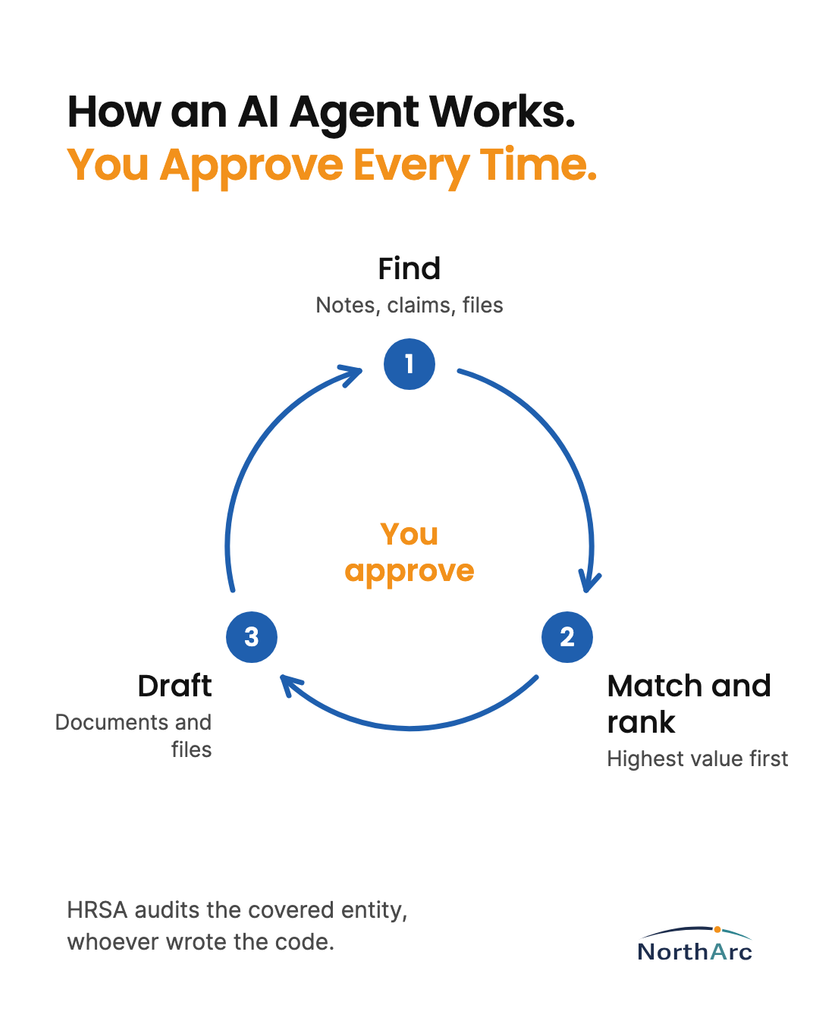
The approval step is the point. HRSA audits the covered entity, whoever wrote the code.
11 practical ways to use AI in 340B
Here are the jobs where AI and AI agents can help a covered entity today. Each one notes whether it’s mainly rules or AI, and where the evidence comes from.
1. Referral capture
An AI agent reads clinical notes, free-text fields, and PDFs in the EHR for evidence of a referral, links each referral to later prescriptions, including at contract pharmacies, ranks them by drug cost, and drafts the referral documentation. This is the clearest case for AI in 340B, because referral evidence is often buried in text that rules can’t read.
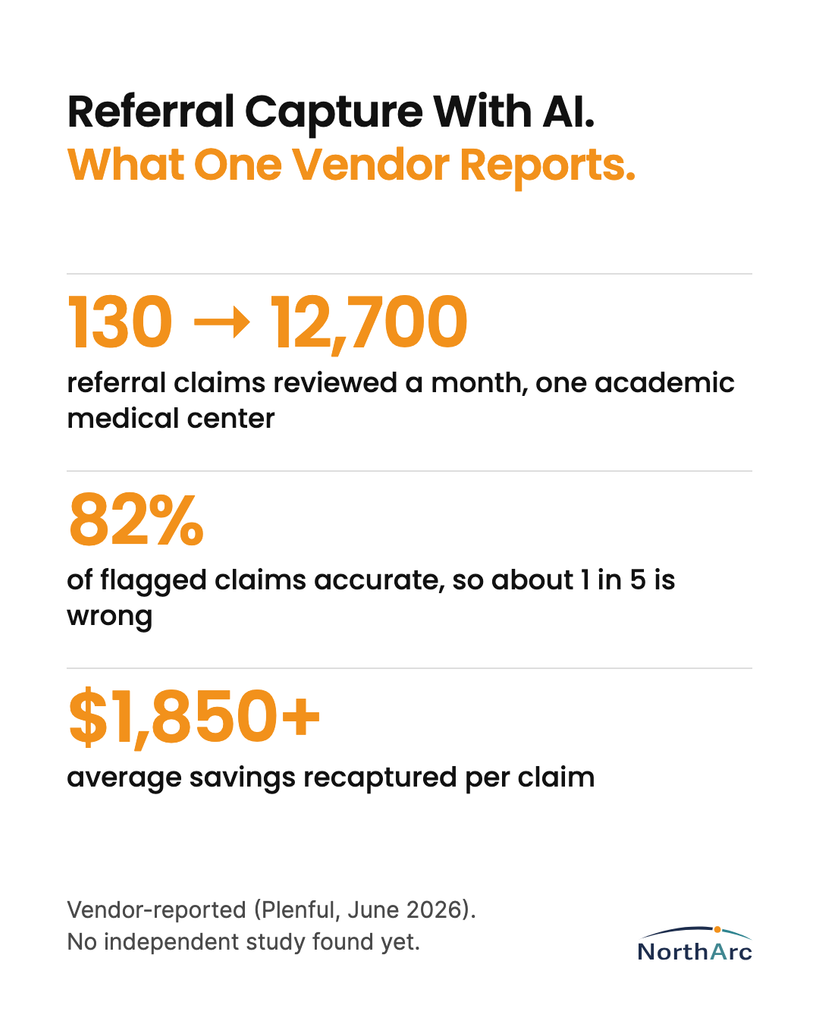
Plenful announced a referral agent in June 2026 and reports that one unnamed academic medical center went from reviewing 130 referral claims a month to 12,700. The same vendor reports 82% accuracy on flagged claims. That means about 1 in 5 flags is wrong, which is exactly why a person must review each one.
2. Checking every claim, not a sample
Rules check 100% of claims for eligibility, and machine learning flags the ones that look unusual for review. Several 340B vendors, including VytlOne and Bluesight, describe auditing every claim instead of a sample. Rules do the checking; AI in 340B claim review helps decide where a person should look first.
3. Cleaning data from many sources
Covered entities get files from TPAs, contract pharmacies, wholesalers and their own sites, each in its own format. AI can help read Excel, CSV, PDF and HL7 files and map them to one standard layout. Ted Houston, 340B program manager at Saint Francis Health System, described the problem on 340B Health’s podcast as “a veritable cornucopia of Excel spreadsheets.” Fewer, cleaner sources make every other check easier, and they are the base for any AI in 340B work.
4. Exception work queues
Some claims fail a check and need a person: a Medicaid claim missing the right submission clarification code, or a patient whose claim was tested at the wrong hospital first. Houston described building these checks himself in Excel and Power BI, holding failed claims and sending them to a work queue. The checks are rules. An agent can add value by sorting the queue, explaining why each claim failed and suggesting the fix.
5. Duplicate discount and diversion monitoring
Continuous monitoring flags possible duplicate discounts, diversion and reporting gaps early, instead of at audit time. This combines rules, such as Medicaid carve-in and carve-out logic, with machine learning that spots patterns across sites and payers. See our guide to 340B audit readiness for the evidence auditors usually ask for.
6. An “ask your policy” assistant
An AI assistant answers staff questions using your own 340B policies and procedures and HRSA guidance, with a link to the source paragraph. New staff stop waiting on the one person who knows. It’s one of the lowest-risk ways to try AI in 340B. Keep it limited to approved documents, so it quotes your policy instead of guessing.
7. Plain-English reports
A leader types “missed savings by site last quarter,” and the AI turns it into a report query. This helps finance and pharmacy leaders get answers without waiting for an analyst or an IT ticket. Houston described IT tickets “not getting serviced for one or two months,” which is the gap this closes.
8. Support ticket triage
AI can sort incoming 340B questions and tickets by issue type, such as eligibility, pharmacy, data or manufacturer, and route them to the right person. It’s a small job, but it saves time every day.
9. Audit prep packets
For each sample claim, an agent gathers the evidence: the encounter, the prescriber, the site’s registration and any referral note, in one file. A person checks the packet before it goes to an auditor. This turns days of searching into a review task.
10. Inventory and replenishment
For entity-owned pharmacies, predictive models can forecast reorders across 340B, GPO and WAC accounts. This is an operational use of AI in 340B, which is where many pharmacy leaders say predictive AI fits best.
11. Preparing outgoing data files
From 2027, the same 340B data has to go out in several directions:
- Drugmakers’ claims-data conditions, through platforms such as 340B ESP.
- Rebate claims through Beacon, if HRSA’s rebate pilot goes ahead on 1 January 2027. A court heard the hospitals’ challenge on 18 November 2026, with no ruling yet.
- The CMS Part D 340B repository, required for claims from 1 January 2027, with the first file due 30 September 2027. See our 340B repository guide.
Each has its own fields and clock. An agent can build each file, check it against the spec, and reconcile what was generated, submitted and accepted. A person submits. For more on submissions, read our guide to 340B claims data submission.
One more idea: an agent that watches drugmaker notices, HRSA updates and state laws, then writes a short weekly “what changed for us” note. We haven’t seen this offered as a product yet, but it’s simple to pilot.
Where should AI not decide in 340B?
AI should not make eligibility, policy or compliance judgment calls in a 340B program. Those stay with people and with clear written rules.
- Eligibility: “Straightforward eligibility and claims management are best handled with clear, rules-based logic” (340B Report, sponsored).
- Policy: “Software cannot make the HRSA-compliant policy decisions that govern eligibility” (VytlOne).
- Grey areas: unusual referral relationships, new sites or mixed-use settings need human judgment.
- Broken data: AI amplifies the systems you have. If your source data is wrong, AI makes the wrong answer faster.
The covered entity is responsible for compliance and can’t hand that to a software company. Our contract pharmacy restrictions guide covers where those responsibilities sit today.
What guardrails does AI in 340B need?
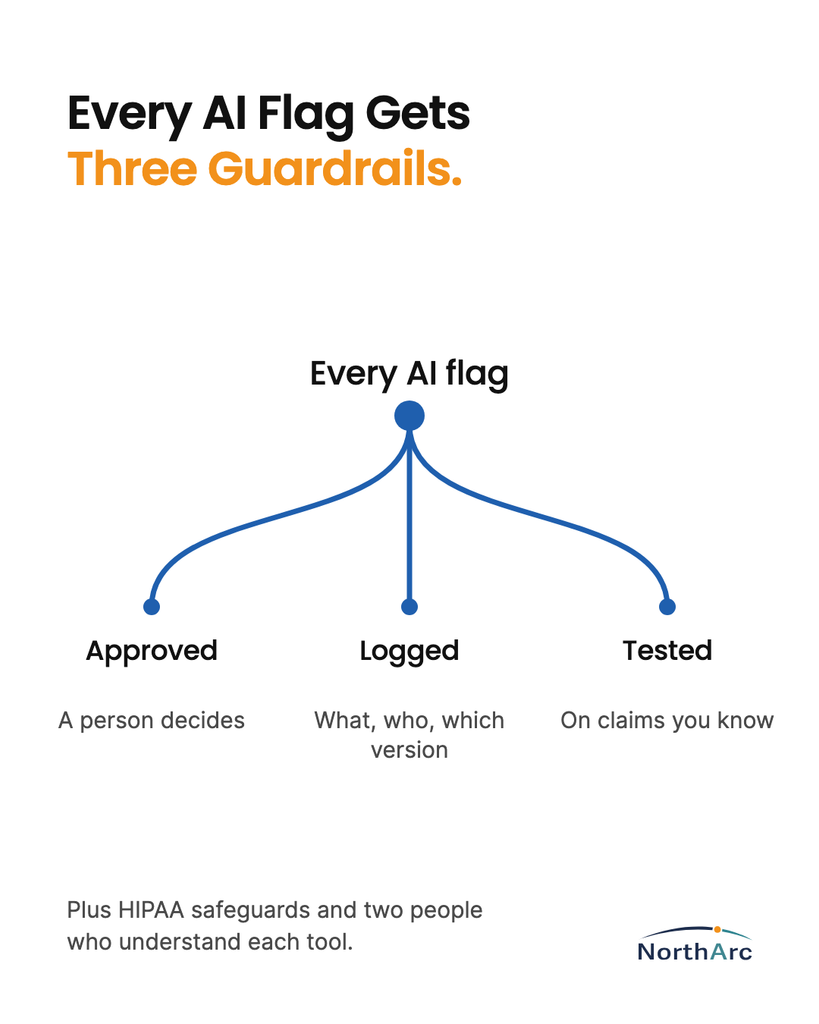
Every tool for AI in 340B needs a person on approval, a full log and regular testing. Here are the six guardrails we’d put in place first:
- A person approves. Any claim AI flags as eligible gets compliance review before it changes a purchase or a repayment.
- HIPAA safeguards. 340B data includes protected health information. Sign a business associate agreement, limit access, and send only the minimum data needed.
- An audit trail. Log what the AI read, what it flagged, who approved it and which version of the logic ran.
- Testing before trust. Run the tool on past claims where you already know the answer, and keep measuring. ASHP’s 2025 statement on AI in pharmacy asks pharmacists to lead validation and ongoing monitoring of AI tools.
- Two people who understand it. Home-built checks fail when their builder leaves.
- Governance. An interdisciplinary group, with pharmacy, compliance, IT and finance, reviews each tool before it goes live.
How much evidence is there for AI in 340B?
Not much independent evidence on AI in 340B exists yet. Most published results come from the companies selling the tools, and we found no peer-reviewed study of AI accuracy or return in 340B, and no HRSA guidance on AI. That doesn’t mean AI doesn’t help. It means you should label vendor numbers as vendor numbers and test on your own data.
| Figure | What it measures | Source |
|---|---|---|
| 130 to 12,700 a month | Referral claims reviewed at one unnamed academic medical center | Plenful, vendor-reported, June 2026 |
| $1,850+ | Average savings recaptured per referral claim | Plenful, vendor-reported |
| 82% | Accuracy on flagged referral claims | Plenful, vendor-reported |
| 5 hours a week | HRSA’s estimate of claims submission time, which hospitals told the court was unexplained | Hospitals’ reply brief, AHA v. Kennedy, 16 November 2026 |
How do covered entities start with AI in 340B?
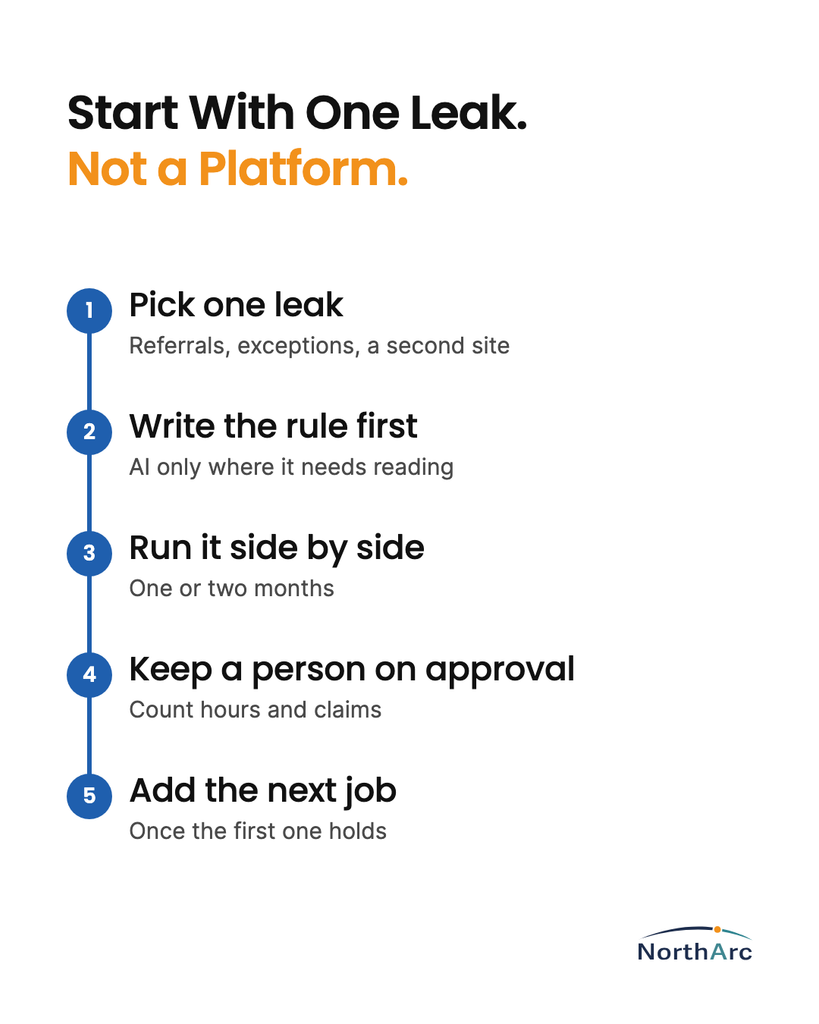
Start AI in 340B with one leak, not a platform. A small team can run a useful pilot in one or two months:
- Pick one leak. Where are eligible claims being missed, or where does work pile up? Referrals, Medicaid exceptions, and second sites are common.
- Write the rule first. If the check can be written as a rule, build it as a rule. Use AI only for the parts that need reading or sorting.
- Run it beside your current process for one or two months, and compare the results claim by claim.
- Keep a person on approval, and measure hours saved and claims recovered.
- Then add the next job.
How NorthArc can help with AI in 340B
NorthArc helps covered entities use AI in 340B safely, starting small. We:
- Pick your first job. We find the one leak where AI pays off first, such as missed referrals or Medicaid exceptions, and keep yes or no checks as plain rules.
- Clean and connect your data. We bring your TPA, pharmacy and EHR files into one clean source, so AI has something reliable to read.
- Test before you trust. We run the tool on past claims where the answer is already known, beside your current process, and count what it catches and what it gets wrong.
- Build the guardrails. A person approves every flag, and each step is logged so an auditor can follow it.
- Check vendor claims. We help you tell real AI from a rule with a new label before you pay for it.
The 2027 Financial and Data Readiness Check is a good place to start. It shows where your data is ready and which job to automate first. Talk to our team.
Sources
- Plenful, The first agent built for 340B referral capture, 10 June 2026 (vendor)
- 340B Report, Separating AI hype from real value in 340B program management, 24 July 2025 (sponsored content, PharmaForce)
- VytlOne, AI and 340B program compliance, January 2025 (vendor)
- Bluesight, 340BCheck (vendor)
- 340B Health, Episode 143 transcript, 31 August 2026
- Federal Register, Notice regarding 340B Rebate Model Pilot Program, 3 August 2026
- ASHP statement on artificial intelligence in pharmacy, AJHP 2025;82(19)
- AHA v. Kennedy, D. Me., hospitals’ reply brief, 16 November 2026
This article is for general information and is not legal advice.