

Securing 340B drug discounts is only one part of running a successful program. You also need to protect those savings through strong compliance controls, accurate records, effective pharmacy oversight, and consistent monitoring. As these responsibilities grow, even experienced internal teams can struggle to keep every part of the program on track.
A 340B consultant helps covered entities keep their program compliant, accurate, and audit-ready. They assess your processes, identify compliance gaps, resolve contract pharmacy and TPA discrepancies, and prepare your team for HRSA audits. With the right support, your team can strengthen program oversight and manage day-to-day operations with greater confidence.
In this blog, we’ll walk through
- Key responsibilities of a 340B consultant
- Challenges in managing 340B programs
- Core services that address those challenges
- How to find the right level of support for your team
What Are the Responsibilities of a 340B Consultant?
A 340B consultant helps you maintain effective program oversight by reviewing operations, identifying potential risks, and recommending improvements. Their work typically covers five areas.
- Assess operations. Review workflows, purchasing practices, and internal controls to find gaps.
- Strengthen compliance. Align program practices with HRSA requirements and help prevent diversion and duplicate discounts.
- Review pharmacy arrangements. Evaluate contract pharmacy relationships, TPA processes, and transaction discrepancies.
- Support audit readiness. Review documentation, flag potential issues, and prepare your team for HRSA audits.
- Guide your team. Recommend improvements, develop policies and procedures, and clarify staff responsibilities.
These responsibilities can vary depending on your organization’s needs and the scope of the consulting engagement.
But why do covered entities need this support in the first place?
To understand that, it helps to look at the operational challenges that can make 340B oversight difficult.
What Challenges Do Covered Entities Face in Managing 340B Programs?
Running a 340B program requires attention to multiple workflows. You oversee purchasing, maintain accurate records, coordinate with outside partners, and keep pace with changing manufacturer requirements. For many teams, the pressure shows up in four key areas.
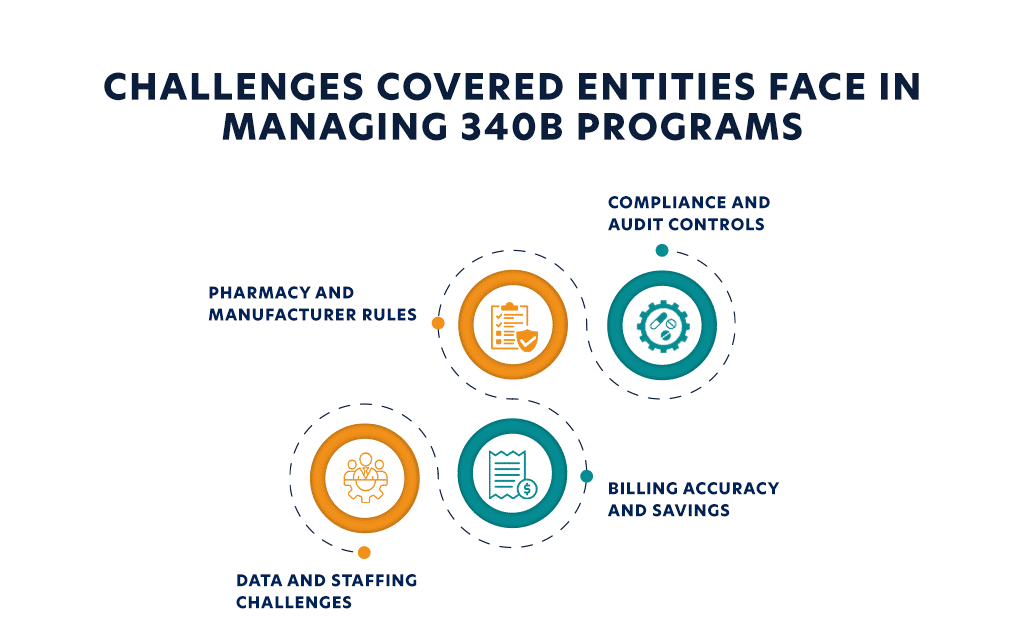
Maintaining Compliance and Audit Readiness
You need records and controls that show your program meets 340B requirements. Preventing diversion and duplicate discounts depends on accurate patient eligibility records, reliable transaction tracking, and regular oversight. Gaps here raise compliance risk and make audit preparation with the Health Resources and Services Administration (HRSA) harder.
Pharmacy Partners and Manufacturer Policies
Contract pharmacy arrangements involve you, your pharmacies, and your third-party administrators (TPAs), and all records must align. Manufacturer policies add contract pharmacy restrictions and extra data or submission requirements. Tracking this across several partners can stretch a small team.
Billing Accuracy and 340B Savings
Errors in claims, drug data, or reimbursement workflows can lead to missed eligible transactions, inaccurate records, and compliance issues. You also need to prevent duplicate discounts, which occur when a manufacturer provides both a 340B discount and a Medicaid rebate on the same drug. Without strong billing controls and reconciliation, you risk lower savings and financial exposure.
Overcoming Data and Staffing Limitations
Effective oversight depends on accurate data from your EHR, pharmacy systems, and TPA platforms. When systems are disconnected or data requires manual handling, reporting, reconciliation, and exception tracking take longer. Smaller teams may also lack the staff capacity or technical resources to keep up.
Together, these challenges can quickly stretch your team’s capacity. The right consulting support can help identify gaps, improve workflows, and strengthen internal controls.
What Services Does a 340B Consultant Provide?
340B consulting services cover a range of advisory, compliance, technical, and operational needs. The right mix depends on your program, systems, and internal capabilities. A consultant should complement your existing team and TPA rather than duplicate their responsibilities.
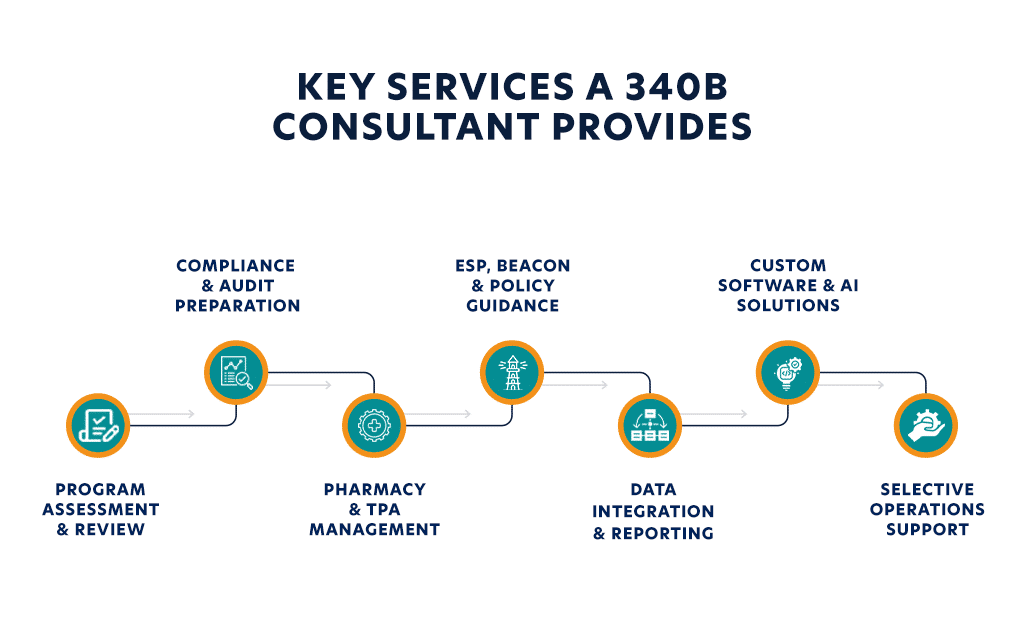
1. 340B Program Assessment and Gap Analysis
A 340B program assessment, sometimes called a health check, gives you a clearer picture of how your program operates and where improvements are needed. A consultant reviews your processes, policies, purchasing practices, and internal controls to identify compliance and operational risks.
You can expect:
- A review of current program practices and controls
- An action plan to address the most important issues
- Identification of compliance risks and operational gaps
This gives your team a practical starting point and helps prioritize the gaps that need attention first.
2. Compliance Monitoring and HRSA Audit Preparation
Compliance requires regular attention, not just preparation when an audit approaches. A consultant can help establish monitoring processes, review program records, and organize the documentation needed to demonstrate compliance.
Support may include:
- Recurring monitoring reports
- Risk and exception tracking
- HRSA audit preparation and audit-binder organization
- Reviews of policies, procedures, and supporting documentation
HRSA recommends quarterly internal audits and annual independent audits of contract pharmacy arrangements. These may be conducted more frequently when necessary. A consultant can help organize this oversight, but your covered entity remains responsible for compliance.
3. Contract Pharmacy Oversight and TPA Reconciliation
Contract pharmacy oversight and TPA reconciliation involve comparing records across your pharmacies, TPA, and internal systems, then investigating discrepancies.
A consultant can help you:
- Reconcile contract pharmacy and TPA reports
- Identify transaction and data discrepancies
- Track unresolved exceptions and coordinate follow-up
- Review reconciliation processes to reduce recurring issues
This work helps maintain consistent records and gives your team better visibility into outstanding discrepancies.
4. ESP, Beacon, and Manufacturer Restriction Management
Manufacturer requirements add complexity to contract pharmacy and rebate workflows. Covered entities must understand applicable policies, organize data, and manage submissions.
340B ESP supports certain manufacturer contract pharmacy policies and claims-data submissions, while Beacon supports separate rebate-related processes, including the 340B Rebate Model.
HRSA’s 340B Rebate Model Pilot Program is scheduled to begin January 1, 2027, covering selected drugs from participating manufacturers. Under this model, covered entities will need to manage additional claims submissions and rebate tracking. This makes accurate data and well-defined submission workflows increasingly important.
Consulting support may include:
- Assessing 340B ESP and Beacon readiness
- Organizing data and submission workflows
- Tracking submissions and unresolved exceptions
- Clarifying responsibilities across teams and partners
If your team needs help preparing, an ESP and Beacon Readiness Review can help you understand the requirements, identify gaps, and organize the next steps.
5. 340B Integrations and Data Solutions
Your 340B oversight depends on reliable information from your TPA and pharmacy platforms. When data is fragmented or handled manually, reconciliation, reporting, and audit preparation become more difficult.
A consultant with technical capabilities can help you:
- Connect selected pharmacy and TPA data sources
- Organize audit evidence and exception reports
- Improve reporting across partners and multiple sites
- Validate recurring data files for accuracy and completeness
More consistent data makes it easier to review exceptions and identify issues across your program.
6. Custom 340B Software and AI-Assisted Workflows
Some consulting providers also develop custom software and AI-assisted workflows for specific operational needs. These solutions can reduce repetitive work, organize information, and support more consistent processes.
Depending on the scope, this may include:
- Defined review and approval steps for staff
- Custom applications for specific 340B workflows
- AI-assisted support for selected operational tasks
- Human review of outputs, exceptions, and follow-up
These are specialized capabilities, not standard services offered by every consultant. Any solution should address a defined need and include appropriate human oversight.
7. Selective Operations Support
Your team may understand what needs to be done but lack the capacity to manage every task consistently. A consultant can provide hands-on support for selected parts of your 340B operations without taking over the entire program.
This may include:
- Assistance with agreed operational workflows
- Tracking outstanding tasks and coordinating follow-up
- Support for selected administrative and program tasks
- Defined procedures, reporting cadence, and status updates
The scope should clarify which responsibilities stay with your team, your TPA, and other partners.
Getting the Right 340B Support for Your Team
The right consultant understands 340B requirements and also fits your program’s needs. Five things help you judge the match. Look for the following.
- Clearly defined services and deliverables
- Experience with covered entities like yours
- The right level of ongoing support for your program
- Strong knowledge of HRSA requirements and 340B compliance
- The ability to work alongside your existing team, TPA, and other partners
Also ask how the consultant reports findings, tracks open issues, and measures progress. A clear scope and practical deliverables make it easier to understand the value of the engagement.
Ultimately, the right 340B consulting services should address your most pressing needs, strengthen program oversight, and help your team manage day-to-day operations with greater confidence.
If you’re not sure where to begin, a 340B Program Health Check gives you a clear view of your gaps and a plan for what to fix first. NorthArc Health works alongside your existing TPA and team, so you don’t have to start over. Talk to our team, and we’ll help you find the right place to start.
Frequently Asked Questions
What qualifications should a 340B consultant have?
Look for hands-on 340B experience, knowledge of HRSA audit requirements, and experience with similar covered entities, such as health centers or critical access hospitals. Ask for a written scope of work outlining expected services and deliverables.
How much does it cost to hire a 340B consultant?
The cost depends on your program’s size, the complexity of your operations, and the level of support you need. A one-time program assessment will have a different cost structure from ongoing monitoring or operational support. Request a written proposal with defined deliverables so you can compare the scope and value of each engagement.
When should a covered entity hire a 340B consultant?
Consider outside support when discrepancies persist, an HRSA audit approaches, staffing is limited, or manufacturer requirements increase your workload. Staff turnover and an overdue program review are also reasons to reassess your current processes. A program assessment can help identify where additional support is needed.
Do 340B consultants provide ongoing program management?
Yes, through ongoing monitoring or selective operations support. A consultant can handle agreed tasks, such as exception tracking and file validation, while your TPA and staff keep their roles. The scope is defined up front, so you know which work stays with your team.