The orphan drug blind spot in 340B refers to the missed financial savings, often ranging from $200,000 to $450,000 annually, by rural and expansion hospitals that fail to capture discretionary pricing on orphan medications. Because of complex exclusions established under the Affordable Care Act, many hospital pharmacy teams mistakenly believe these high-cost specialty drugs are entirely ineligible for 340B-equivalent pricing. This misconception leads to significant revenue leakage in organizations that desperately need those funds to support their critical care missions and community outreach programs.
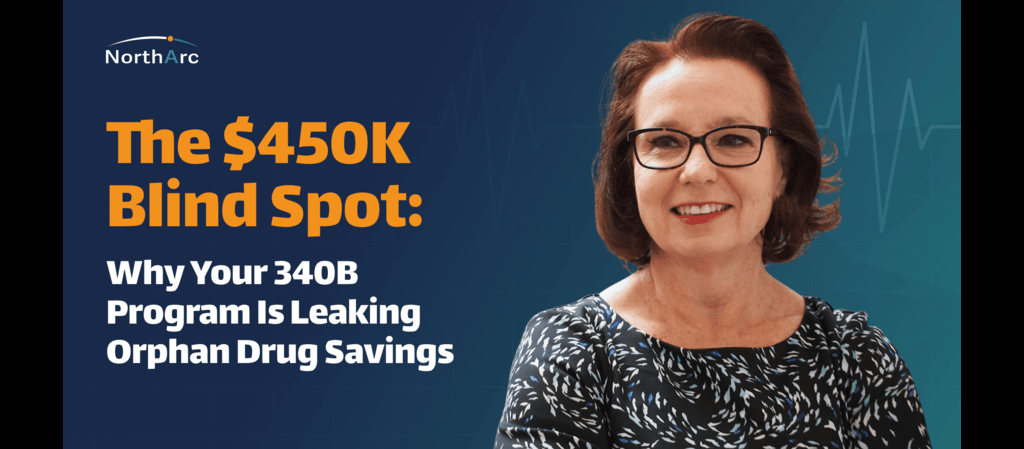
In a recent episode of 340B Pulse by NorthArc Health, Mohammad Atif and Salman Asif spoke with Lisa Nezneski, founder of 340B Orphan Drug Solutions. With over two decades of experience helping smaller hospitals uncover hidden revenues, Lisa reveals that most teams fundamentally misunderstand the mechanics of 340B orphan drug pricing. This detailed guide explores how orphan drugs function inside the existing 340B framework, why many hospitals believe there is nothing left to gain, and how real savings can be identified, validated, and operationalized.
Why Are Orphan Drugs Excluded from Standard 340B Pricing?
Orphan drugs are excluded from mandatory 340B pricing for certain entities due to specific legislative nuances introduced by the 2010 Affordable Care Act and clarified in subsequent 2015 legal rulings. Specifically, for Critical Access Hospitals (CAHs), Sole Community Hospitals (SCHs), Rural Referral Centers (RRCs), and Free-standing Cancer Centers, orphan drugs are not formally classified as “covered outpatient drugs” under the standard 340B statute.
Because these drugs are technically “excluded” from mandatory 340B pricing mandates for these entities, pharmaceutical manufacturers are not legally required to offer them at the 340B ceiling price. This exclusion was originally intended to protect the economic viability of developing drugs for rare diseases (which have small patient populations), ensuring manufacturers could still recoup their research and development investments. However, this legal distinction created an unintended operational gap: because the drugs are formally excluded, hospital pharmacy teams simply assume they cannot obtain any discounts at all.
How Does Discretionary Pricing Work for Orphan Drugs?
Discretionary pricing actively bridges the gap left by historical exclusions, allowing manufacturers to voluntarily offer 340B-equivalent or similar discounts on orphan drugs at their own discretion. Rather than facing a strict statutory mandate, pharmaceutical companies can choose to extend favorable pricing to rural and expansion entities, meaning these hospitals can still access massive savings if they know how to pursue them.
Despite not being an automatic ceiling price, discretionary pricing behaves very similarly to traditional 340B discounts when properly configured within a hospital’s procurement systems. The challenge is that this pricing is entirely voluntary on the manufacturer’s part. As a result:
Availability is Volatile: Manufacturers can offer, modify, or revoke these discounts at any time.
Tracking Requires Vigilance: As manufacturers spin off subsidiaries, acquire smaller companies, or change National Drug Codes (NDCs), the eligibility for discretionary pricing must be constantly monitored.
The Assumption Barrier: As Lisa Nezneski notes, “People think that you cannot get access unless you are monitoring the diagnoses… They don’t even bother to go after it because they think they can’t get it.”
Analyzing pharmaceutical spend often reveals orphan drugs making up to 80% of total budgets.
What Are the Most Common Operational Mistakes Leading to Missed Savings?
The most common operational mistake hospitals make is improper setup in their split-billing software and Third-Party Administrators (TPAs), typically either actively blocking all orphan drug NDCs or leaving the system completely open without proper tracking. Because standard 340B operations emphasize compliance, teams frequently rely on automated lists without engaging in the active, ongoing management that discretionary pricing requires.
Hospitals often believe that simply “creating a list” is sufficient to handle the orphan drug exclusion. In reality, managing these high-cost drugs effectively is an ongoing process. A single missed medication or an item purchased on the wrong account can result in a devastating budget impact. Key operational breakdowns often involve:
1. Over-Restriction in TPAs: To avoid compliance violations, some TPAs automatically block all orphan drug NDCs for smaller hospitals, preventing the accumulation needed to buy at the discretionary price.
2. Under-Restriction in TPAs: Conversely, some systems leave the gates wide open, leading to the accumulation of drugs that shouldn’t be captured.
3. Set-It-and-Forget-It Mentalities: Not anticipating changes in manufacturer classifications, NDCs, or corporate structures leads to outdated system logic and lost savings.
How Can Critical Access and Rural Hospitals Quantify Their Opportunity?
Critical Access and rural hospitals can quickly quantify their orphan drug opportunity by establishing a baseline understanding of the percentage of their total drug budget that is allocated to orphan medications. From there, they can compare their current capture rate against what optimized, active orphan drug management could unlock, effectively validating the financial opportunity before committing extensive operational resources to it.
It is surprisingly common for leaders to assume orphan drugs are a small, niche tier of medicine. However, Lisa emphasizes that she has never evaluated a hospital where orphan drugs constituted less than 50% of the total drug budget, with some facilities reaching as high as 80%. When a hospital manages a $15 million or $30 million annual spend, failing to capture discretionary pricing on half of that inventory represents mathematical devastation.
Why Is a 340B Orphan Drug Savings Spreadsheet Essential?
A dedicated savings spreadsheet or estimator tool is essential because it translates abstract revenue potential into clear, leadership-friendly financial models, actively demonstrating the delta between immediate current capture and the maximum potential of a well-managed program. The model highlights exactly what assumptions matter most and where the data needs alignment.
When organizations use robust estimator frameworks, the results are often striking. Unlocking discretionary discounts frequently yields $200,000 to $450,000 in annualized savings, often within the first quarter of deployment. These tools are critical for:
Showing how orphan drug opportunities persist inside already active programs.
Framing the conversation for CFOs and CEOs regarding ROI, risk mitigation, and mission impact.
Guiding the transition from theoretical “savings potential” directly into validated, actionable operational plans.
How Do Third-Party Administrators (TPAs) Impact Orphan Drug Savings Capture?
TPAs impact orphan drug savings by acting as the gatekeepers of software configuration and accumulator logic; if the TPA’s baseline settings do not explicitly accommodate the nuances of discretionary pricing, the savings will never be realized by the hospital. Finding the gap is only half the battle—operationalizing the fix requires expertly navigating the TPA’s distinct capabilities and limitations.
Furthermore, relying too heavily on a TPA to proactively manage the pharmaceutical supply chain is a significant risk. Manufacturers are constantly acquiring, spinning off, or introducing new NDCs. Every time an NDC changes hands, the 340B discretionary eligibility must be tracked and updated within the TPA. Covered Entities that take a passive approach, assuming their TPA will catch every nuanced change, inevitably leave money on the table.
What Steps Should Pharmacy Leaders Take to Protect Meaningful Pricing?
Pharmacy leaders must actively bridge the gap between identifying theoretical savings and executing practical operational workflows by engaging in comprehensive cross-departmental coordination, rigorous quarterly reviews, and granular TPA configuration management. Success relies heavily on ongoing analysis rather than treating orphan drug capture as a one-time setup project.
To begin protecting and capturing this value, teams should implement the following best practices:
Establish Baseline Metrics: Determine precisely what percentage of your total drug budget is tied up in orphan medications.
Audit Current TPA Logic: Review split-billing rules to understand exactly how your software currently handles orphan drug NDCs (e.g., “blocked” vs. “wide open”).
Implement Iterative Reviews: Because this segment of the budget is highly volatile, ensure ongoing savings analysis and quarterly reviews are part of standard operating procedures.
Create Defensible Documentation: Keep robust records of decision-making and configuration changes to ensure actions are easily explainable during a HRSA or independent review.
Why Do Hospitals Hesitate to Address the Orphan Drug Blind Spot?
Hospitals frequently hesitate to address the orphan drug blind spot due to a psychological fear among pharmacy leaders that identifying past missed savings will be interpreted by administration as a failure of past management or compliance. They fear “getting in trouble” for leaving money on the table, rather than viewing the discovery as a massive new opportunity for the hospital’s non-profit mission.
“They think that they’re gonna get in trouble because they missed opportunities,” Lisa Nezneski explains. “But you need a mental reframe of that… you’re bringing an opportunity to administration, so you are the hero.” When pharmacy teams approach executives with a plan that leverages a nuanced understanding of 340B to generate an additional $400,000 for critical community programs, it transforms the narrative from one of past oversight to proactive, strategic value creation.
How Does NorthArc Health Support 340B Covered Entities?
NorthArc Health supports 340B Covered Entities by providing specialized consulting and technology infrastructure to navigate complex pricing nuances, uncover hidden savings, and bulletproof the program against audits without disrupting existing workflows. NorthArc serves as an execution-level partner, working alongside your current TPAs rather than trying to replace them, to guarantee total program clarity.
Navigating the shifting landscape of orphan drug pricing requires more than just manual spreadsheets. What NorthArc Enables:
Surgical Program Visibility: Rapidly uncover hidden savings and resolve deep data blind spots.
Absolute Audit Readiness: Navigate the complexities of ESP, Beacon, and HRSA requirements with confidence and defensible documentation.
Targeted Operational Support: Reduce daily operational burdens with practical, system-grounded recommendations tailored specifically for rural and expansion entities.
Your orphan drug savings are out there. It’s time to claim them.
Please use the links below for the podcast
Youtube :Finding the Missing $200K – $450K: The Orphan Drug Blind Spot in 340B | 340B Pulse
Spotify : Finding the Missing $200K – $450K: The Orphan Drug Blind Spot in 340B | 340B Pulse
Apple. : Finding the Missing $200K – $450K: The Orphan Drug Blind Spot in 340B | 340B Pulse
Amazon : Finding the Missing $200K – $450K: The Orphan Drug Blind Spot in 340B | 340B Pulse
Frequently Asked Questions (FAQ)
What are 340B orphan drugs?
Orphan drugs are pharmaceutical products developed specifically to treat rare medical conditions affecting a small number of patients. Under the 340B program, these drugs are explicitly excluded from mandatory manufacturer discounts for certain hospital types, including Critical Access Hospitals (CAHs), Sole Community Hospitals (SCHs), and Rural Referral Centers (RRCs).
Can Critical Access Hospitals get 340B pricing on orphan drugs?
While manufacturers are not legally required by the 340B statute to offer ceiling prices on orphan drugs to CAHs, many choose to offer equivalent discounts voluntarily through “discretionary pricing.” Hospitals must actively identify these opportunities and correctly configure their systems to capture these savings.
How much money are hospitals losing on the orphan drug blind spot?
According to industry experts, rural and expansion entities often miss between $200,000 and $450,000 in annualized savings by failing to manage their orphan drug accumulations and discretionary pricing accurately within their split-billing software.
Why doesn’t our Third-Party Administrator (TPA) catch these savings automatically?
TPAs process claims based on the logic rules established during setup. Many TPAs take a conservative approach, defaulting to blocking all orphan drug accumulations for rural hospitals to prevent non-compliance. Continuous, proactive management is required to adjust these settings as manufacturer discretionary pricing behavior changes.
Are orphan drugs a significant portion of a hospital’s drug budget?
Yes. Despite their classification for “rare diseases,” a significant number of high-cost medications hold orphan designations. In many facilities, orphan drugs account for 50% to 80% of the entire pharmaceutical spend, making their effective management a critical financial priority.